Design for Deconstruction: Strategies for Circular Design
As design professionals, we often imagine our buildings standing for generations, but the reality is far different. Buildings are frequently demolished before their intended lifespan due to shifts in market demands or programmatic needs. Despite an average design life of around 60 years, structures are frequently torn down prematurely, contributing to a growing waste problem. The U.S. Environmental Protection Agency has estimated that over 600 million tons of construction and demolition debris is generated annually in the United States. That’s equal to about 2,000 Empire State Buildings!
This reality presents an alarming challenge but also an opportunity for the design industry. If our buildings are not truly permanent, then we must begin designing with their end of life in mind. Rather than contributing to a linear system of extraction, use, and disposal, architects and designers can play a pivotal role in advancing a circular economy, one where materials are intentionally preserved, recovered, and reused, by designing for deconstruction.
What is Design for Deconstruction (DfD)?
Designing for Deconstruction (DfD), also known as Design for Disassembly, is an approach to sustainable architecture that involves designing buildings so they can be systematically taken apart at the end of their life. Instead of demolishing structures and sending the debris to landfills, DfD enables materials and structural components to be salvaged in their most valuable form.
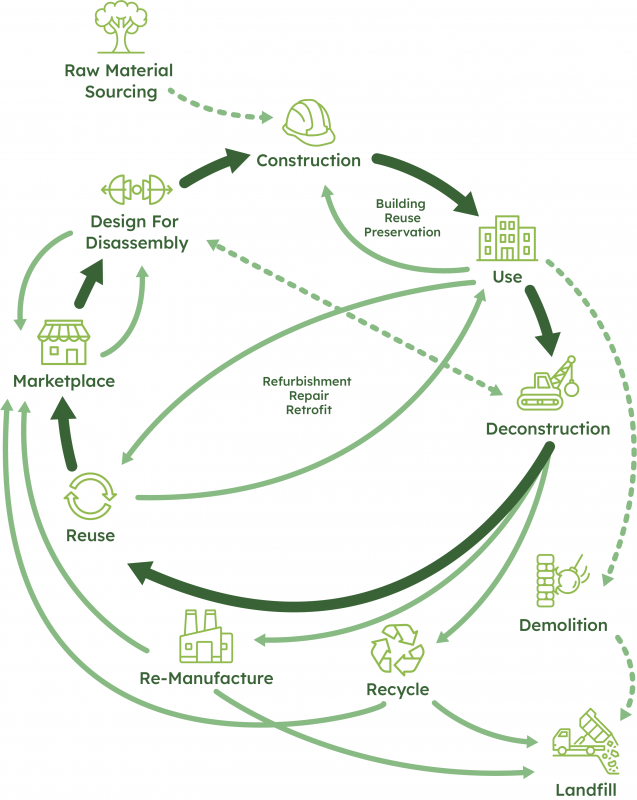
This approach challenges the conventional linear system of building materials and instead promotes a circular model, as shown in our graphic above. Materials in this model retain their integrity, value, and usefulness beyond a single building’s lifespan. Structural systems, facade materials, and interior components can be reused in future projects, reducing demand for virgin materials, minimizing waste, and giving new life to what might have otherwise been sent to a landfill.
Designing for Deconstruction is both a technical strategy and a shift in mindset. It asks project teams to think beyond initial construction and consider the full lifecycle of a building—from assembly to disassembly.
Why Design for Deconstruction Matters in Sustainable Architecture
Design for Deconstruction plays a critical role in advancing sustainable architecture by addressing one of the industry’s largest challenges: waste. By enabling materials to be recovered and reused, DfD reduces construction and demolition debris while lowering the demand for new raw materials.
This approach also has a measurable impact on embodied carbon. Extending the life of materials reduces the need for new manufacturing and extraction, which are among the most carbon-intensive phases of the building lifecycle. As sustainability standards continue to evolve, including LEED v5, the industry is placing greater emphasis on these full lifecycle impacts.
Beyond environmental benefits, DfD introduces new economic opportunities. Salvaged materials retain value and can be reused or resold, while emerging policies and incentives increasingly support deconstruction over demolition. At the same time, it reframes buildings as long-term material assets rather than disposable structures.
As the built environment responds to changing market demands and sustainability goals, Design for Deconstruction positions project teams to create buildings that are not only adaptable in use, but also responsible for how they ultimately come apart.
Key Considerations for Design for Deconstruction
Successful implementation of DfD requires early planning and collaboration across the entire project team. While every project is unique, several factors influence feasibility:
- Time – Time can be one of the most significant factors in pursuing DfD strategies. These decisions must be made early in the design process. Alignment between architects, engineers, contractors, and owners is critical, and additional coordination and documentation may be required.
- Project Typology – Different building types have different lifespans and functional demands. For example, commercial buildings experience more frequent turnover and renovations, making them strong candidates for adaptable and DfD systems. In contrast, infrastructure or institutional buildings prioritize long-lasting, durable construction, but can still benefit from selective DfD strategies.
- Cost – Cost considerations can vary widely depending on location and market considerations. While deconstruction may involve higher labor cost compared to demolition (depending on their experience), these can potentially be offset by reduced landfill fees and the resale value of salvaged materials. As material reuse markets grow, the financial case for DfD continues to strengthen.
- Market Demand – The success of material reuse depends on the availability of markets and infrastructure to support it. Designers should consider whether reclaimed materials can realistically be resold, repurposed, or reintegrated into new construction projects. If there are already programs in place for materials now, it strengthens the business case for DfD.
Design Strategies for Deconstruction
Implementing Design for Deconstruction strategies does not require reinventing the building process. Instead, it involves making intentional decisions about materials, systems, and connections.
- Prioritize high-value materials that will retain their integrity, and therefore their value, and can be reused or repurposed.
- Minimize material diversity to simplify sorting and recovery at the end of life.
- Use mechanical fasteners (bolts, screws, clips) instead of adhesives which make separation difficult or can diminish the integrity of the materials.
- Design visible and accessible systems, avoiding concealed connections behind walls and ceiling where possible.
- Disentangle building systems, such as separating structural, mechanical, and electrical components to allow independent removal.
- Standardize and modularize design elements, making components easier to remove, replace, and reuse.
- Incorporate material labeling or documentation into drawings, sometimes referred to as “material passports,” to track components for future use.
These strategies not only support deconstruction but also improve flexibility during a building’s life, making renovations more efficient.
Material Passports and Digital Tracking
One of the emerging tools that strengthens the success of Design for Deconstruction is the use of material passports. A material passport is a digital record that documents the components of a building by tracking information such as material type, quantity, manufacturer, installation method, and potential for reuse.
These passports act as a bridge between design intent and future recovery. While DfD strategies make disassembly possible, material passports make it practical. Decades after construction, when original drawings may be lost or incomplete, a material passport provides a clear roadmap for what exists within a building and how it can be reclaimed.
As digital tools and building information modeling (BIM) continue to evolve, material passports are becoming increasingly feasible to implement. When paired with thoughtful design strategies, they transform buildings into material banks.
Policies and Incentives for Deconstruction
Across the United States, local governments are starting to recognize the environmental and economic benefits of deconstruction. Cities such as Portland, Oregon; San Antonio, Texas; and Chapel Hill, North Carolina have introduced policies that encourage or mandate deconstruction over demolition for certain building types or materials.
For example, some cities require older buildings to be deconstructed rather than demolished, so that valuable materials like wood, brick, and fixtures are salvaged. Others offer financial incentives, reduced permit fees, or tax benefits to projects that prioritize material recovery and reuse. These policies not only reduce landfill waste, but also create local job opportunities in deconstruction and material resale industries.
As more jurisdictions adopt similar regulations, DfD is likely to become not just a best practice, but a standard expectation within the industry.
How LEED v5 Supports Design for Deconstruction
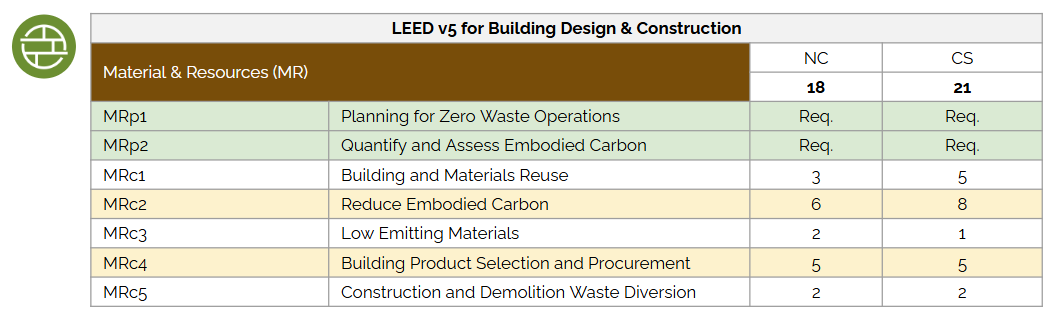
The latest evolution of the LEED rating system, v5, places a stronger emphasis on decarbonization and material circularity than ever before. Within the Material and Resources category, credits have expanded from 13 to 18, reflecting a growing focus on embodied carbon, life cycle impacts, and resource conservation.
These changes signal a broader industry shift that sustainability is no longer just about operational energy but about the full lifecycle of materials. Designing for Deconstruction directly supports these goals by extending the life of materials and reducing the carbon footprint associated with new extraction and manufacturing.
Design for Reuse, Not Waste
Ultimately, designing for deconstruction is about responsibility. As design professionals, we shape not only the built environment of today but the material resources of tomorrow. Every detail, connection, and material specification has implications beyond the life of a single building. By integrating DfD principles early in the design process, we can create buildings that are not only beautiful and functional but also regenerative and resource-conscious. We can reduce waste and contribute to a more sustainable and circular future.
The question is no longer whether our buildings will come down, but how and when. We have the power to ensure that when they do, they leave behind opportunity rather than waste.