How the 2021 IBC Changed Podium Construction for Mixed-Use Developers
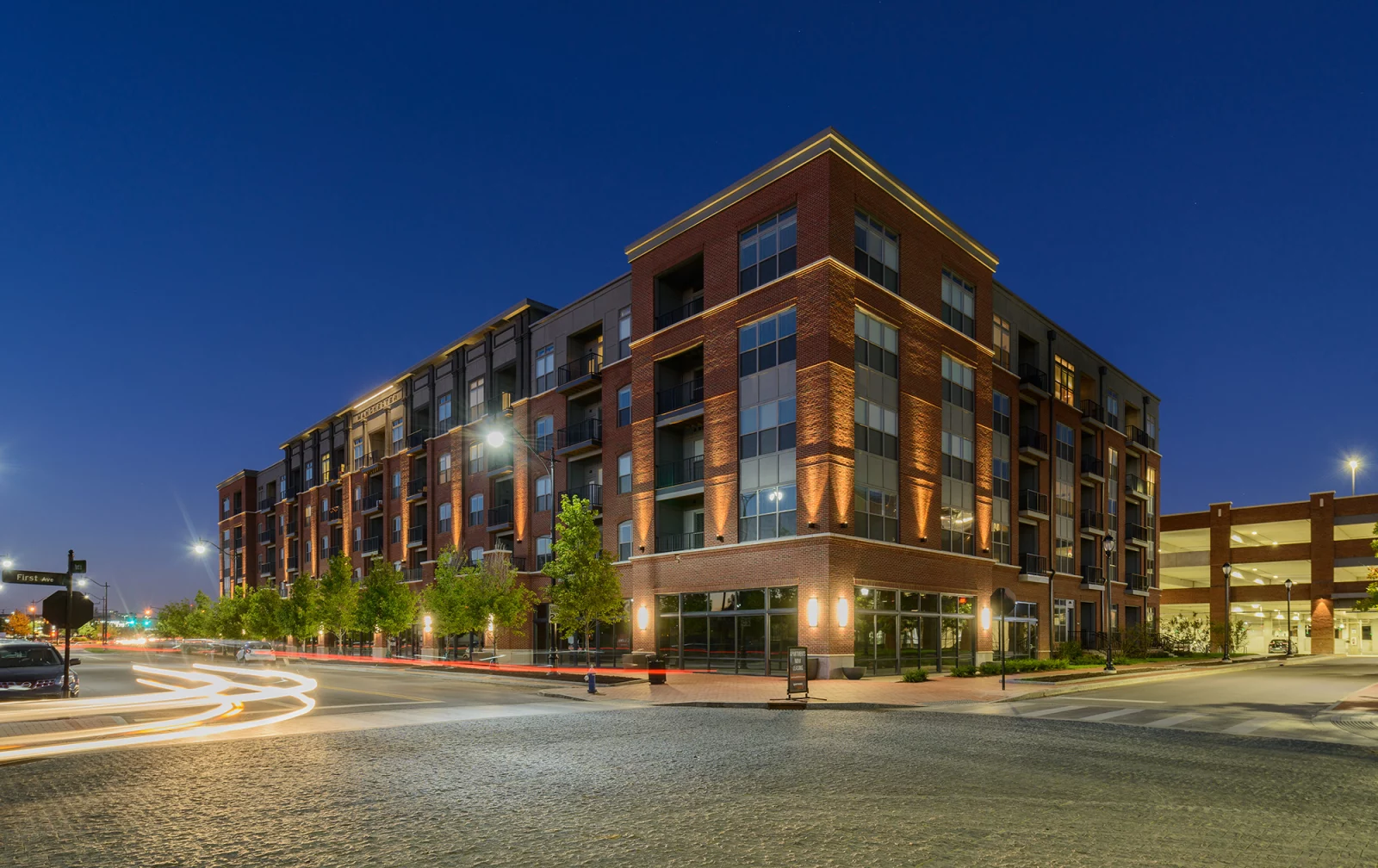
Over the last decade, the podium building became a prominent feature of American multifamily construction. Its telltale design of a concrete base topped by wood-frame construction went from novel to typical in just a few years. The design methodology simplified and reduced the cost for building mid-rise multifamily structures by locating mixed-use spaces and/or parking below, with less expensive wood-frame residential construction above. Project teams could use the typical NFPA 13 system below, and the less expensive 13R system above the podium, resulting in a major cost advantage.
That all changed in the 2021 International Building Code when one of the cost advantages for podium structures, the NFPA 13R system became more stringent. At the time, I expressed concern, unsure if states would abandon these stricter requirements, similar to how many rejected the IRC’s residential sprinkler requirement (currently only 2 states maintain the requirement). When Ohio adopted the 2021 IBC, I often stated during presentations I gave on the significant changes, that developers and their architects would need to reevaluate if the podium structure still made economic sense or if other code alternatives needed consideration.
Now, nearly two years into the 2021 IBC adoption in Ohio, podium structures, which at one time seemed the basis for all multifamily construction, are no longer the default solution for multifamily projects. Instead, they are only one tool among many. Understanding when to use that tool and when not to has become a critical strategic decision. Deciding when a podium creates value, and when alternative code paths offer greater flexibility, has become a strategic decision for developers.
The following examines those alternatives and explores how they will shape the next generation of mixed-use and multifamily construction. As housing demand intensifies and communities increasingly grow up rather than out, understanding these code strategies will directly influence how projects are planned, financed, and built.
The Decline of the Podium
What changed for podium buildings? With a few simple word changes to IBC section 903.3.1.2 regarding NFPA 13R sprinkler systems, much of the economic advantage for podium structures vanished.
First, the code added the words “above grade plane” to the requirement that a building be limited to only four stories. Previously the four story limitation could be measured from the podium level. More impactful was the second change: the floor level of the highest story could no longer exceed 30 feet from the lowest level of fire department vehicle access.
Those simple changes didn’t magically eliminate podium structures, but with the cost advantage of using an NFPA 13R sprinkler system gone, more traditional approaches requiring less gymnastics became more appealing. Type III and type V Construction, already common in multifamily buildings,once forced to use NFPA 13 system for buildings greater than 4 stories became unburdened from the height and area limitations of NFPA 13R systems. Below is a quick comparison of these construction types under both NFPA 13 and 13R.
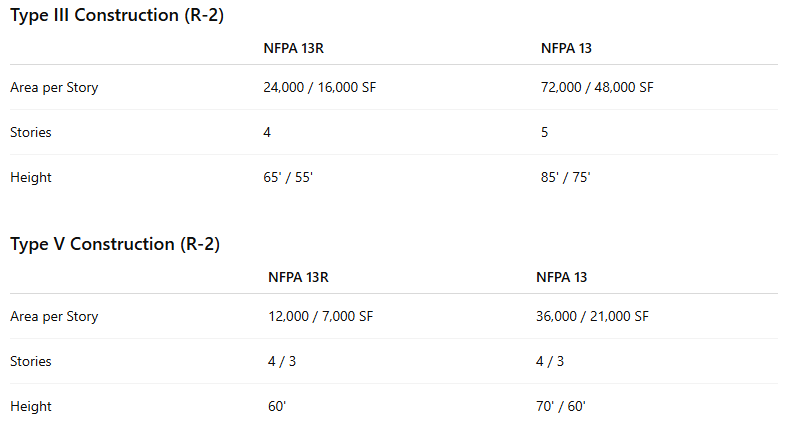
The takeaway: once NFPA 13 became necessary for most applications, many developers could achieve greater area and height using conventional Type III or Type V construction, without the structural complexity of a podium.
A podium structure which had made sense for four or five story buildings no longer provided cost benefits in the size and scale most developers sought. After all there is no restriction on the construction type used for enclosed parking garages, as well as assembly or mercantile spaces, which were often located on the first floor of these structures. Even though the allowable number of stories didn’t always align, the extra height and added stories could be obtained by designing using a separated mixed-use strategy that only required a 2-hour horizontal assembly rating instead of the 3-hour rating found in podium structures.
Alternatively IBC 510.4 and 510.7 become options as podium alternatives. Let’s look at each of these in more detail.
IBC 510.4
IBC 510.4 provides a strategic alternative.
510.4 allows the number of stories of Use Group R buildings of any construction type located above one story of Type I or Type IV S2 parking to be measured from the top of the parking level, provided there is a two-hour separation between the residential area above and the parking below. This is similar to podium structures, but could, for instance, achieve six stories without a traditional podium structure in type III A and B NFPA 13 sprinklered buildings. The limitation is that this alternative does not allow for more than a single level of parking on the first floor nor does it allow for alternative uses such as retail.
IBC 510.7
Unlike 510.4, 510.7 does not allow measuring the number of stories from the top of the parking level. But it does provide a few potentially valuable alternatives under the right project circumstances:
- This section allows for uses other than R2 above an open parking garage and allows for R, A, I, B or M above the rated assembly.
- The number of open parking garage stories is not limited unlike in 510.4.
- In states like Ohio that have eliminated sprinkler requirements for open parking garages, since 510.7 references 406.5 it could be interpreted that the sprinkler requirement does not apply to the open parking garage below the horizontal separation.
Furthermore, because the horizontal separation between the upper and lower uses creates two distinct buildings due to different construction types, it can also be interpreted that if the building above the separation is sprinklered, it still receives the area increase for being fully sprinklered. This is likely a hard sell to a building department, but the code language supports it.
One important caveat to this section is that the means of egress serving the upper portion of the building must be separated from the open parking garage. An open stair serving more than the open parking garage would not be permitted.
For mixed-use developers, this section can provide significant design and cost flexibility — particularly when structured parking is part of the project program.
Where Podium Construction Still Makes Sense
Despite these shifts, podium construction still has advantages that would appeal to developers and designers and as structures get taller new opportunities.
As mentioned earlier, even the buildings in our suburbs are growing up. More buildings are being designed and built taller than three stories. However, as already discussed, podium structures do not provide a cost benefit in buildings consisting of four or five stories but without question the one niche podium structures easily rise above are six story multifamily buildings. With mixed use on the first floor or even R2 throughout, a podium structure easily can accommodate four to five stories above the podium using wood construction with only one or two stories of type IA construction beneath the concrete podium.
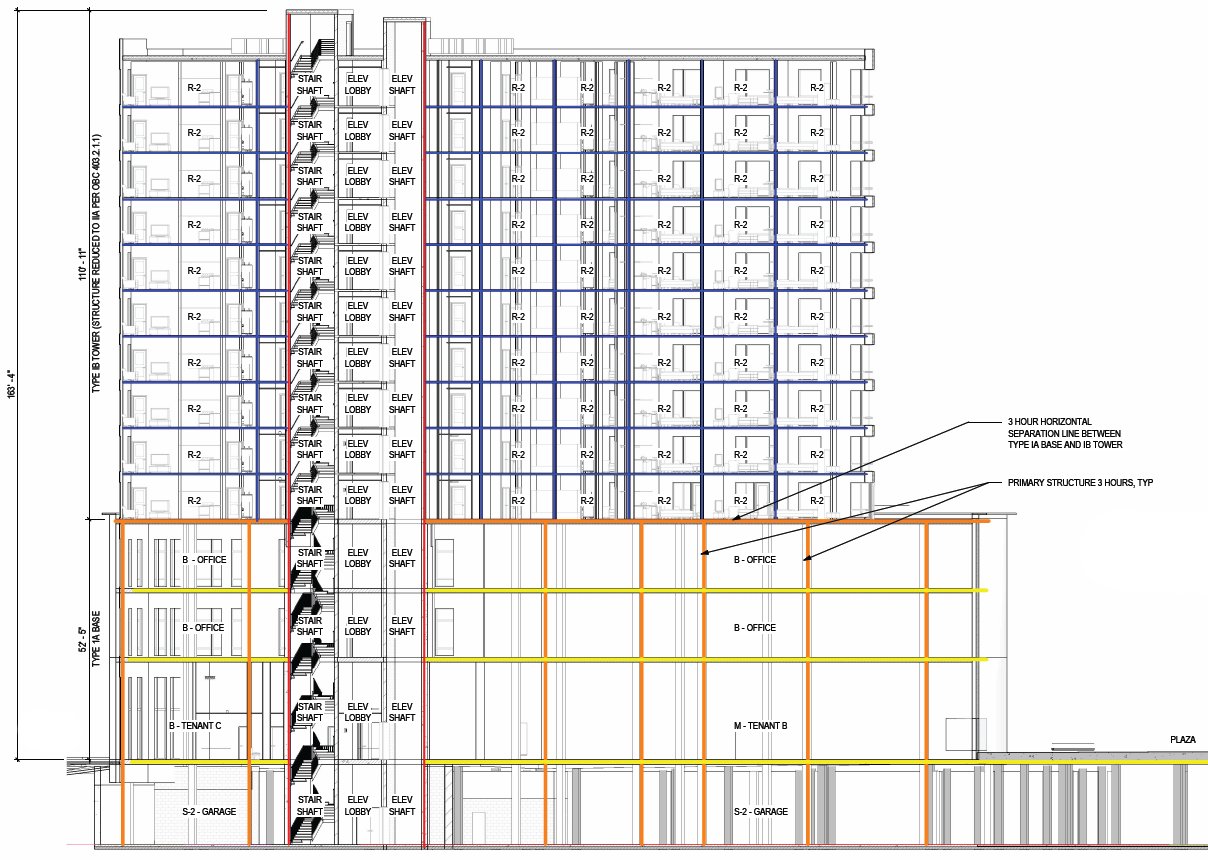
In most scenarios a building above six stories meets the definition of a high-rise building, but even here a podium design might offer budgetary relief to a creative design team. 403.2.1-2 allows buildings except of use groups F-1, H-2, H-3, H-4, H-5 and M, to be reduced from Type IB construction to Type IIA construction. This is inherent in high-rise structures so there is no benefit to using a podium unless you want to build taller than 12 stories. Here’s where math matters.
The reason why podiums are desirable is that there is a wide gap between the allowable building height and the allowable number of stories. The allowable height for IB is 180 feet while the number of stories is limited to 12. Meaning a typical floor to floor height of 12 feet may result in a building height of 144 feet but the building could be 36 feet taller. A podium design could unlock potentially three additional stories since it allows for the number of stories above the podium to be measured from the top of the podium rather than grade.
There are other benefits as well. When you look at the list of uses that cannot use this IIA reduction, you see the usual cast of characters but also ‘M’ for mercantile. Separating the mercantile use below the podium allows a project to take full advantage of the change in construction type allowed by the high-rise section of the building code in buildings greater than six stories and less than 12 stories if an M use will be present on the lower floors. If you are wondering what the difference is between IB and IIA the impact is to require fire ratings allowing the structural frame and floors of the proposed building to be reduced from 2 hour-rated construction to 1 hour-rated construction.
The Future of Multifamily Construction
The 2021 IBC did not eliminate podium construction. It only added limitations on where those cost advantages could provide the most benefit.
For developers, the question is no longer “Should we build a podium?” but rather:
- What is our target height?
- How many stories do we need?
- Is structured parking required?
- Are mercantile or assembly uses part of the program?
- What are the fire department access elevations?
- Does the project benefit more from Type III/V with NFPA 13?
- Would 510.4 or 510.7 create greater efficiency?
In today’s environment with rising construction costs, housing shortages, and growing suburban density, code strategy is development strategy.
The most cost-effective mixed-use and multifamily projects are no longer defined by a single building type. They are defined by a careful evaluation of height limits, construction types, occupancy separations, and sprinkler requirements under the adopted code.
Podium construction remains viable. But its value now depends on precision — not habit.
For developers operating in Ohio and similar jurisdictions, early collaboration between ownership, the architect, and code expertise can unlock options that materially affect feasibility, pro forma performance, and long-term return.